
Steroids for vestibular neuritis are widely advised after a sudden, days-long spinning attack, yet the best-known review of the evidence calls their support insufficient. Vestibular neuritis is the second most common cause of peripheral vertigo and accounts for about 7% of patients seen in dizziness clinics [Fishman, Corticosteroids for the treatment of idiopathic acute vestibular dysfunction (vestibular neuritis), 2011]. The theory, the trial results and the current guidelines do not line up neatly.
Why Steroids Make Sense in Theory
Vestibular neuritis is a sudden loss of balance signals from one inner ear, with hearing left intact. Its cause is not settled. The leading hypothesis is that herpes simplex virus type 1 reactivates in the vestibular nerve and triggers inflammation [Strupp, Methylprednisolone, valacyclovir, or the combination for vestibular neuritis, 2004].
Anatomy gives a second reason. In temporal bone studies, the bony channel of the superior vestibular nerve is about seven times longer than that of the inferior vestibular nerve, and narrower [Gianoli, Anatomic differences in the lateral vestibular nerve channels and their implications in vestibular neuritis, 2005]. A swollen nerve in a long, tight tunnel may be more easily compressed, which fits the usual involvement of the superior division. Bell’s palsy offers a parallel: there, a facial nerve inflamed inside a bony canal recovers better with early steroids. All of this makes a benefit plausible. None of it shows that steroids help.
Two Kinds of Recovery: The Test and the Patient
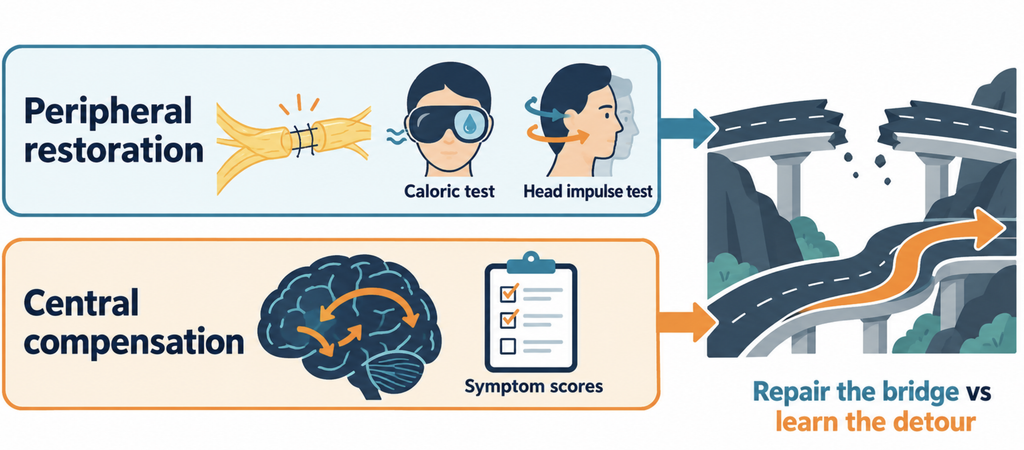
Recovery happens on two tracks. The first is peripheral restoration, the nerve itself coming back, which a caloric test or video head impulse test measures. The second is central compensation: the brain recalibrates so that a weaker ear no longer makes the room seem to move. Patients feel the second track.
Picture a washed-out bridge on one side of a highway. Steroids might speed up the repair crew, but most drivers have already found a detour. In a prospective study of 40 patients, disability at follow-up was predicted by visual dependence, anxiety and autonomic arousal, and not by vestibular test results [Cousins, Predictors of clinical recovery from vestibular neuritis: a prospective study, 2017]. That gap explains part of why steroid studies reach conflicting conclusions.
What Trials Show About Steroids for Vestibular Neuritis
The 2004 trial that started it
The landmark trial randomized 141 patients to placebo, methylprednisolone, valacyclovir, or both. At 12 months, peripheral vestibular function had improved by 62.4 percentage points with methylprednisolone and by 39.6 with placebo. The antiviral added nothing [Strupp, Methylprednisolone, valacyclovir, or the combination for vestibular neuritis, 2004]. The trial measured caloric test function and did not use symptoms as its outcome.
Meta-analyses: better calorics, not clearly better patients
| Review | Caloric recovery | Symptoms or disability |
|---|---|---|
| Cochrane, 2011 (four trials, 149 patients) | Better at one month, not at 12 months | No difference |
| Leong, 2021 | Better at one month only | No difference |
| Kim, 2022 | Better, including long-term | No clear benefit |
| Bogdanova, 2022 (15 trials) | Odds ratio 2.4 | Not assessed separately |
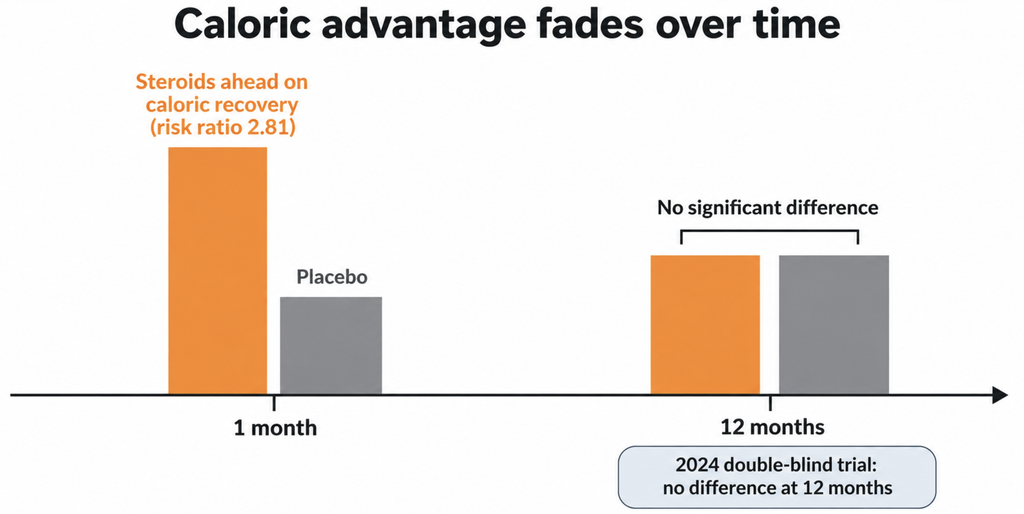
In the Cochrane review, patients on steroids were more likely to show complete caloric recovery at one month (risk ratio 2.81). By 12 months the difference had faded, and dizziness scores did not differ [Fishman, Corticosteroids for the treatment of idiopathic acute vestibular dysfunction (vestibular neuritis), 2011]. The most favorable analysis put the number needed to treat at 7 for restored vestibular function, but its authors warned that heterogeneity and risk of bias allow only a cautious judgment [Bogdanova, Corticosteroids in patients with vestibular neuritis: an updated meta-analysis, 2022].
The newest double-blind trial
A 2024 Swedish trial randomized 69 emergency patients to placebo, a 3-day course or a 10-day course, each starting with 8 mg intravenous betamethasone. All groups improved. At 12 months, neither steroid course beat placebo on caloric function, head impulse gain or dizziness questionnaires [Sjögren, Acute unilateral vestibulopathy and corticosteroid treatment, 2024]. The trial was small, but it was blinded and placebo-controlled, which many earlier studies were not.
Steroids versus vestibular rehabilitation
In a trial of 40 patients, 50% of those on steroids and 45% of those doing vestibular exercises had complete resolution at 12 months, and the difference was not significant [Goudakos, Corticosteroids and vestibular exercises in vestibular neuritis, 2014]. A pooled analysis of 12 randomized trials and 536 patients found that rehabilitation alone matched steroids alone, and that the combination outperformed steroids alone [Huang, Efficacy of vestibular rehabilitation in vestibular neuritis, 2024].
Does Timing Matter? The 24–72 Hour Window
Timing may account for some of the mixed results. In a series of 33 patients, everyone treated within 24 hours had a normal caloric test at 3 months, compared with 58% of those treated between 25 and 72 hours [Sjögren, Steroids for acute vestibular neuronitis, 2019]. The series was small and not randomized, and early presenters may have differed in other ways.
Oral vs Intravenous Steroids for Vestibular Neuritis
A PubMed search for this article found no trial that compared intravenous and oral steroids directly in vestibular neuritis. In an emergency department trial of 100 patients, intravenous dexamethasone did not reduce hospital admissions [Adamec, Intravenous dexamethasone in acute management of vestibular neuritis, 2016]. In a trial of 26 patients, 5 mg intravenous dexamethasone relieved nausea and dizziness no better than saline [Kim, The effect of intravenous dexamethasone on the nausea accompanying vestibular neuritis, 2015].
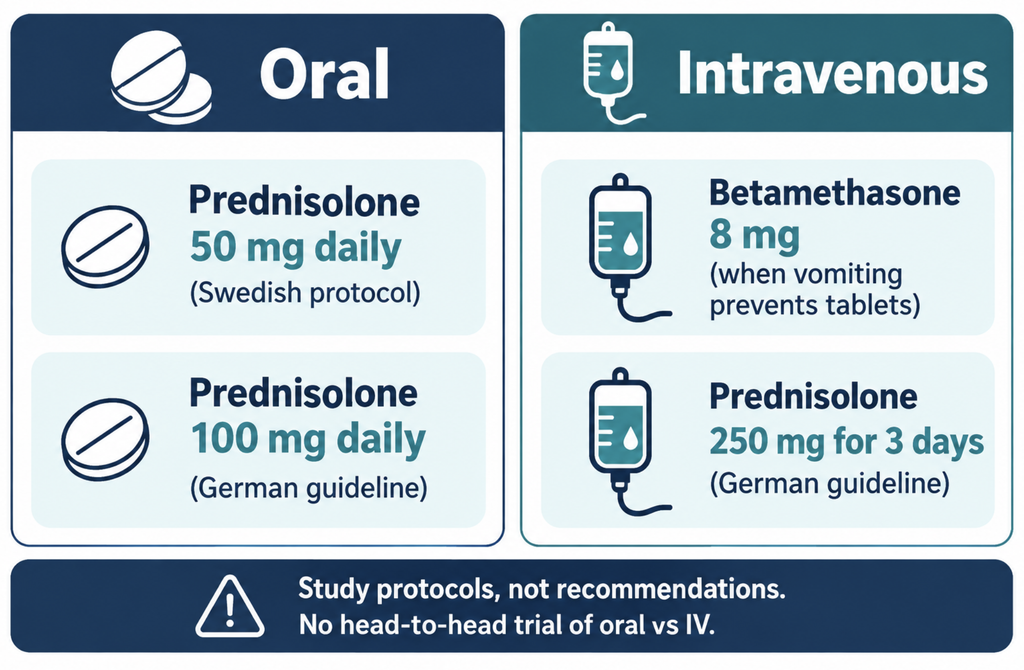
Doses vary widely. One Swedish protocol used 50 mg oral prednisolone daily and switched to intravenous betamethasone only when vomiting made tablets impossible [Sjögren, Steroids for acute vestibular neuronitis, 2019]. A German guideline lists either 100 mg oral prednisolone or 250 mg intravenous prednisolone for 3 days, and notes that both schemes still need placebo-controlled confirmation [DEGAM, Schwindel in der Hausarztpraxis, 2026]. In practice, the route matters mainly when a patient cannot keep pills down.
What Current Guidelines Recommend
| Source | Year | Position on steroids |
|---|---|---|
| GRACE-3 (emergency medicine) | 2023 | Consider short-term steroids within the first 3 days, through shared decision-making |
| Cochrane review | 2011 | Insufficient evidence to support use |
| German primary-care guideline (DEGAM) | 2026 | Steroids should be given in the acute phase; consensus-based |
GRACE-3 recommendation 14 presents steroids as an option to discuss with the patient rather than a default, and rates the supporting evidence as very uncertain [Edlow, Guidelines for reasonable and appropriate care in the emergency department 3 (GRACE-3), 2023]. The German guideline is more permissive, but it rests on expert consensus. Rehabilitation has stronger support: physical therapy guidelines recommend it for unilateral vestibular loss on strong evidence [Hall, Vestibular rehabilitation for peripheral vestibular hypofunction, 2022].

Who Should — and Shouldn’t — Get Steroids
Steroids have side effects. In a meta-analysis of 15 trials, adverse effects were more frequent with steroids (odds ratio 10.9, number needed to harm 4), though the margin of error around that estimate is very wide [Bogdanova, Corticosteroids in patients with vestibular neuritis: an updated meta-analysis, 2022]. Doctors should use steroids with caution in people with diabetes, peptic ulcer disease, poorly controlled hypertension or active infection.
Diagnosis comes first, because a brainstem or cerebellar stroke can mimic vestibular neuritis. Korean national claims data from 2007 to 2022 covered 237,673 patients. Of these, 9.8% received steroids, and 63.2% of those treated were women. The authors suggested that vestibular migraine may be underdiagnosed and that steroids are sometimes misused [Yoon, Nationwide trends in steroid therapy for vestibular neuritis, 2025].
Clinical Perspective. Steroids for vestibular neuritis give the peripheral nerve a modest, optional push; they are not what decides recovery. A confirmed diagnosis, early movement and vestibular rehabilitation matter more. For patients who arrive late or carry steroid risks, skipping steroids is a reasonable choice.
Key Takeaways
- Steroids for vestibular neuritis improve caloric test recovery most clearly in the first month. Reviews disagree on whether the advantage lasts to 12 months.
- A consistent benefit on dizziness or disability scores has not been shown, and a 2024 double-blind, placebo-controlled trial found none either.
- No trial has compared intravenous and oral steroids directly. Intravenous dosing is mainly a workaround when vomiting prevents tablets.
- Vestibular rehabilitation has the strongest support of any treatment, with or without steroids.
FAQ
Do steroids help vestibular neuritis?
Partly. They speed nerve recovery on caloric testing, but the advantage often fades by 12 months, and they have not been shown to make patients feel better in the long term [Sjögren, Acute unilateral vestibulopathy and corticosteroid treatment, 2024].
How soon should steroids be started?
Within the first 3 days. Guidelines limit the option to that window, and a small non-randomized series suggested that treatment within 24 hours gave better caloric results [Sjögren, Steroids for acute vestibular neuronitis, 2019].
Are IV steroids better than oral steroids?
That is not known. No trial has compared them head to head, and the existing intravenous trials showed no clear short-term benefit over placebo [Adamec, Intravenous dexamethasone in acute management of vestibular neuritis, 2016].
Can vestibular neuritis get better without steroids?
Yes. Patients on placebo also improved substantially, and vestibular exercises produced long-term results similar to steroids [Goudakos, Corticosteroids and vestibular exercises in vestibular neuritis, 2014].
References
- Fishman JM, Burgess C, Waddell A. Corticosteroids for the treatment of idiopathic acute vestibular dysfunction (vestibular neuritis). Cochrane Database Syst Rev. 2011;(5):CD008607.
- Strupp M, Zingler VC, Arbusow V, et al. Methylprednisolone, valacyclovir, or the combination for vestibular neuritis. N Engl J Med. 2004;351(4):354-61.
- Gianoli G, Goebel J, Mowry S, Poomipannit P. Anatomic differences in the lateral vestibular nerve channels and their implications in vestibular neuritis. Otol Neurotol. 2005;26(3):489-94.
- Cousins S, Kaski D, Cutfield N, et al. Predictors of clinical recovery from vestibular neuritis: a prospective study. Ann Clin Transl Neurol. 2017;4(5):340-346.
- Leong KJ, Lau T, Stewart V, Canetti EFD. Systematic review and meta-analysis: effectiveness of corticosteroids in treating adults with acute vestibular neuritis. Otolaryngol Head Neck Surg. 2021;165(2):255-266.
- Kim G, Seo JH, Lee SJ, Lee DH. Therapeutic effect of steroids on vestibular neuritis: systematic review and meta-analysis. Clin Otolaryngol. 2022;47(1):34-43.
- Bogdanova A, Dlugaiczyk J, Heckmann JG, Schwab S. Corticosteroids in patients with vestibular neuritis: an updated meta-analysis. Acta Neurol Scand. 2022;146(5):429-439.
- Sjögren J, Fransson PA, Magnusson M, Karlberg M, Tjernström F. Acute unilateral vestibulopathy and corticosteroid treatment – a randomized placebo-controlled double-blind trial. J Vestib Res. 2024 Dec 18;35(2):91-101.
- Goudakos JK, Markou KD, Psillas G, Vital V, Tsaligopoulos M. Corticosteroids and vestibular exercises in vestibular neuritis. Single-blind randomized clinical trial. JAMA Otolaryngol Head Neck Surg. 2014;140(5):434-40.
- Huang HH, Chen CC, Lee HH, et al. Efficacy of vestibular rehabilitation in vestibular neuritis: a systematic review and meta-analysis. Am J Phys Med Rehabil. 2024;103(1):38-46.
- Sjögren J, Magnusson M, Tjernström F, Karlberg M. Steroids for acute vestibular neuronitis-the earlier the treatment, the better the outcome? Otol Neurotol. 2019;40(3):372-374.
- Adamec I, Krbot Skorić M, Gabelić T, et al. Intravenous dexamethasone in acute management of vestibular neuritis: a randomized, placebo-controlled, single-blind trial. Eur J Emerg Med. 2016;23(5):363-9.
- Kim JC, Cha WW, Chang DS, Lee HY. The effect of intravenous dexamethasone on the nausea accompanying vestibular neuritis: a preliminary study. Clin Ther. 2015;37(11):2536-42.
- DEGAM. S2k-Leitlinie Schwindel in der Hausarztpraxis. AWMF-Register Nr. 053-018. Deutsche Gesellschaft für Allgemeinmedizin und Familienmedizin; 2026.
- Edlow JA, Carpenter C, Akhter M, et al. Guidelines for reasonable and appropriate care in the emergency department 3 (GRACE-3): acute dizziness and vertigo in the emergency department. Acad Emerg Med. 2023;30(5):442-486.
- Hall CD, Herdman SJ, Whitney SL, et al. Vestibular rehabilitation for peripheral vestibular hypofunction: an updated clinical practice guideline from the Academy of Neurologic Physical Therapy of the American Physical Therapy Association. J Neurol Phys Ther. 2022;46(2):118-177.
- Yoon CY, Kong TH, Seo YJ, Park JY. Nationwide trends in steroid therapy for vestibular neuritis: insights from South Korea’s health insurance review and assessment data. Front Neurol. 2025;16:1560388.
Joonpyo Hong, MD is a board-certified otolaryngologist practicing in Korea. This article reflects his clinical interpretation of published research and does not constitute individual medical advice.
For more articles:
https://curiousmd.com/vestibular-neuritis/
https://curiousmd.com/vestibular-migraine-vs-menieres-disease/
https://curiousmd.com/medical-questionnaires-validity/
Link out to:
https://www.cochrane.org/evidence/CD008607_corticosteroids-treatment-idiopathic-acute-vestibular-dysfunction-vestibular-neuritis — Cochrane’s plain-language summary of the review on corticosteroids for vestibular neuritis.
https://www.saem.org/publications/grace/grace-3 — The Society for Academic Emergency Medicine’s GRACE-3 guideline on acute dizziness and vertigo, including its steroid recommendation.
https://vestibular.org/article/diagnosis-treatment/types-of-vestibular-disorders/labyrinthitis-and-vestibular-neuritis/ — The Vestibular Disorders Association’s patient overview of labyrinthitis and vestibular neuritis.
https://www.msdmanuals.com/professional/ear-nose-and-throat-disorders/inner-ear-disorders/vestibular-neuronitis — MSD Manual Professional summary of vestibular neuronitis and its treatment options.