
Most reviews of vestibular schwannoma symptoms and treatment start with slow, one-sided hearing loss. A harder case is sudden hearing loss that improves with steroids while MRI still shows a tumor. Among 1,698 patients with sudden sensorineural hearing loss (SSNHL) at one Korean center, 43 (2.5%) had a vestibular schwannoma [Lee, VS steroid response, 2022].
What Is a Vestibular Schwannoma, and Why Was It Called an Acoustic Neuroma?
A vestibular schwannoma is a benign tumor of the Schwann cells on the vestibular division of cranial nerve VIII. It makes up about 8% of intracranial tumors [Hamiter, MSD vestibular schwannoma, 2025] and about 80% of cerebellopontine angle (CPA) tumors [Wasano, VS-associated SSNHL, 2021]. Recent population incidence estimates are 3.0 to 5.2 per 100,000 person-years [Marinelli, Global VS incidence, 2022]. More than 95% are sporadic and one-sided [Mayo Clinic, VS treatment decisions, 2022]. Bilateral tumors suggest NF2-related schwannomatosis, formerly neurofibromatosis type 2 [Plotkin, NF2 nomenclature, 2022].
The old name(acoustic neuroma) is wrong on two counts. The tumor usually grows from the vestibular nerve rather than the acoustic (cochlear) nerve, and it is made of Schwann cells, not neurons. The 1991 NIH consensus conference therefore preferred the term vestibular schwannoma [NIH, Acoustic neuroma consensus, 1991].
Hearing Loss or Dizziness: Which Symptom Is More Common?
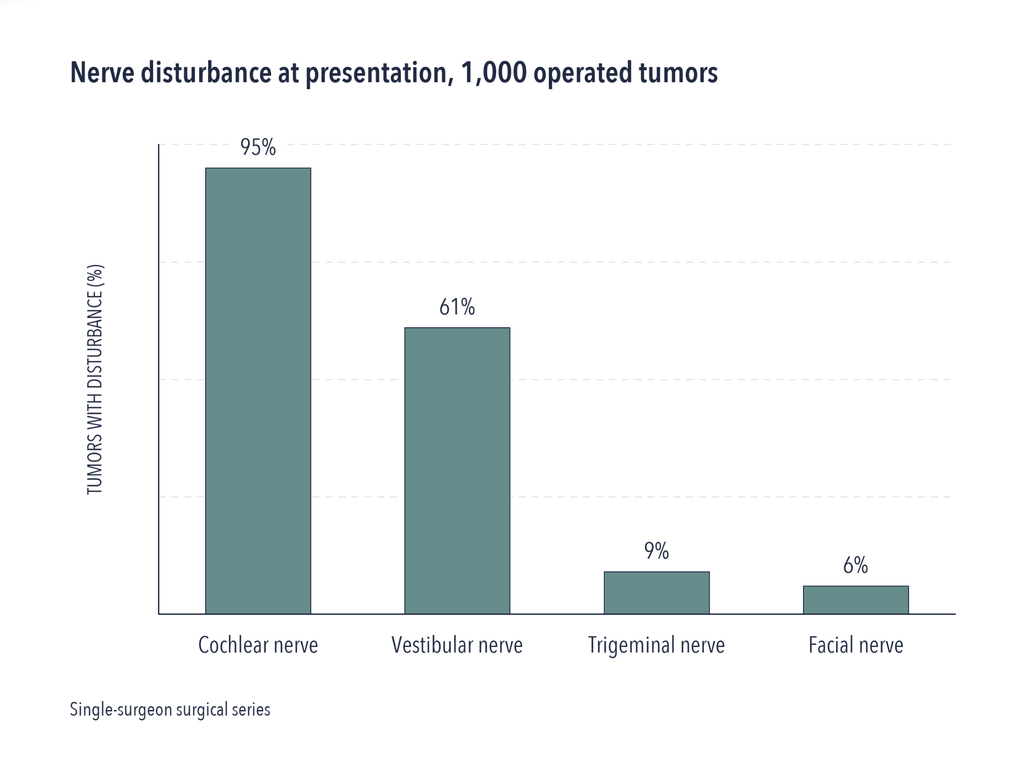
Hearing symptoms are more common than dizziness. In a surgical series of 1,000 tumors, cochlear nerve disturbance was found in 95% and vestibular disturbance in 61% [Matthies, 1000 vestibular schwannomas, 1997]. Vestibular symptoms were usually unsteadiness when walking or vertigo, and they often came and went. Dizziness likely stays mild because slow tumor growth allows central compensation.
The typical hearing loss is gradual and one-sided, with speech discrimination worse than the pure-tone thresholds predict [Hamiter, MSD vestibular schwannoma, 2025]. Sudden loss is less common: in 139 operated tumors, 20% had an episode of SSNHL at some point, and earlier reports range from 3% to 23% [Sauvaget, SSNHL revealing VS, 2005].
Sudden Hearing Loss and Steroids in Vestibular Schwannoma
About 2% to 3% of patients with SSNHL have a vestibular schwannoma. The rate was 2.5% in the Korean series [Lee, VS steroid response, 2022] and 3.0% among 499 imaged patients in Japan [Fujita, VS prevalence in SSNHL, 2019].
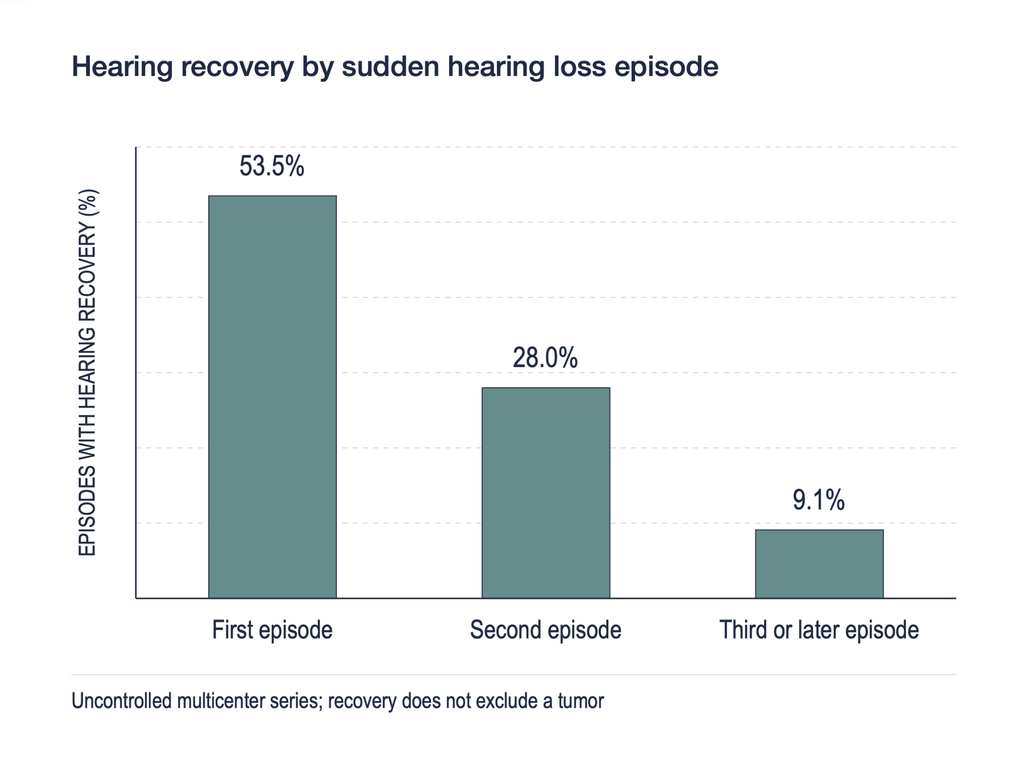
In uncontrolled series, hearing often improves after steroids. Good recovery occurred in 34.3% of 32 treated Korean patients [Lee, VS steroid response, 2022]. In a US series, 6 of 10 patients had a meaningful audiometric gain [Huynh, VS steroid efficacy, 2023]. A Japanese multicenter series found that recovery fell with each new episode: 53.5% after the first, 28.0% after the second, and 9.1% after the third or later [Wasano, VS-associated SSNHL, 2021]. The estimated chance of a new episode within 1 year was 25%.
Why Recovery Does Not Rule Out a Tumor
The Korean authors concluded that hearing recovery does not exclude a tumor [Lee, VS steroid response, 2022]. The AAO-HNS guideline recommends evaluating patients with SSNHL for retrocochlear pathology with MRI or auditory brainstem response (ABR) [Chandrasekhar, Sudden hearing loss guideline, 2019]. Audiometric follow-up alone no longer counts as that workup. The US authors concluded that a known tumor does not rule out a steroid trial for a new sudden drop [Huynh, VS steroid efficacy, 2023].
Is a Biopsy Needed? How MRI Confirms the Diagnosis
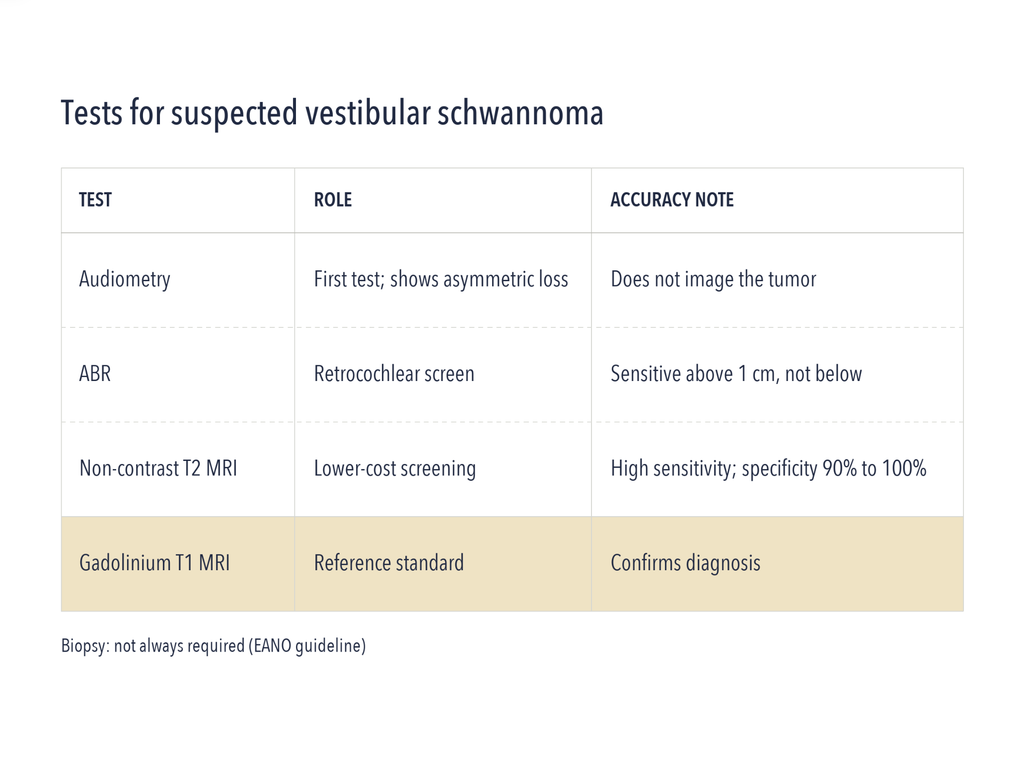
A biopsy is usually not needed: the European Association of Neuro-Oncology (EANO) guideline bases the diagnosis on MRI and states that tissue confirmation is not always required [Goldbrunner, EANO VS guideline, 2020]. Gadolinium-enhanced T1-weighted MRI is the reference standard [Fortnum, MRI for acoustic neuroma, 2009].
ABR cannot replace MRI, because its sensitivity is high for tumors larger than 1 cm but not for smaller ones. In the same systematic review, non-contrast T2 protocols had high sensitivity and a specificity of 90% to 100% against gadolinium T1 and were more cost-effective [Fortnum, MRI for acoustic neuroma, 2009].
Can Medicine Treat Vestibular Schwannoma?
Drug therapy has no established role in sporadic tumors: the EANO guideline sees a role only for bevacizumab in NF2 [Goldbrunner, EANO VS guideline, 2020]. Steroids for a sudden drop treat only the hearing episode.
Meta-analyses of retrospective cohorts found no significant association between aspirin use and tumor growth [Ignacio, Aspirin meta-analysis, 2021; Zalaquett, Medical therapy meta-analysis, 2026]. The newer analysis tied metformin to lower odds of growth (pooled OR 0.46, 3 retrospective studies). The authors judged this too weak for routine use. In NF2-related schwannomatosis, a bevacizumab meta-analysis found partial regression in 41% of tumors, hearing improvement in 20% of tested patients, and serious toxicity in 17% [Lu, Bevacizumab in NF2, 2019].
Matching Vestibular Schwannoma Symptoms and Treatment: When Surgery Makes Sense
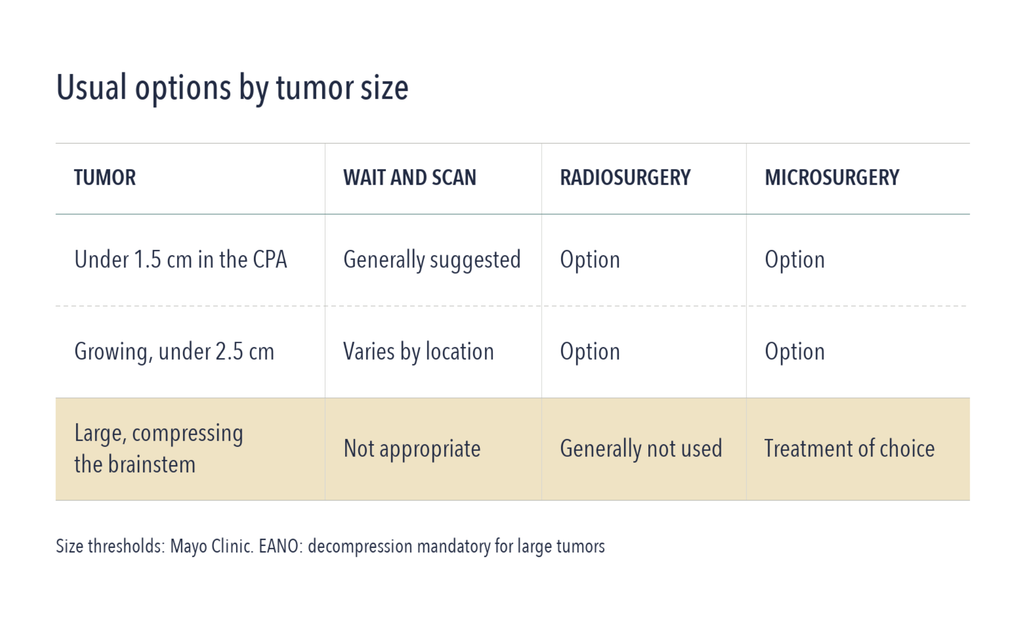
In a Danish national cohort of 2,312 observed patients, most tumors did not grow: 21% of intrameatal and 37% of extrameatal tumors grew within 5 years [Reznitsky, VS growth natural history, 2021]. At 10 years, the figures were 25% and 42%, and most growth happened in the first 5 years. Mayo Clinic generally suggests wait-and-scan for tumors under 1.5 cm in the CPA [Mayo Clinic, VS treatment decisions, 2022]. The 2018 Congress of Neurological Surgeons (CNS) imaging guideline recommends MRI every year for 5 years, then longer intervals if the tumor is stable [Dunn, CNS imaging guideline, 2018].
For patients with serviceable hearing at diagnosis, pooled estimates from separate cohorts put 10-year hearing preservation at 47% with observation, 38% after radiosurgery, and 32% after microsurgery [Daher, CNS hearing preservation update, 2026].
For tumors under 3 cm, a meta-analysis found tumor control in 92% after radiosurgery and 98% after microsurgery [Savardekar, Microsurgery vs radiosurgery, 2022]. Facial nerve dysfunction was less common after radiosurgery (2% vs 10%). Radiation suits small or medium tumors without significant brainstem compression and is often chosen for older patients [Hamiter, MSD vestibular schwannoma, 2025].
Microsurgery is the treatment of choice for large tumors that compress the brainstem or cause hydrocephalus. Mayo Clinic generally treats confirmed growth with radiosurgery or microsurgery [Mayo Clinic, VS treatment decisions, 2022]. In Denmark, most intrameatal tumors that grew stayed under observation, while most extrameatal ones had surgery [Reznitsky, VS growth natural history, 2021]. The EANO guideline calls surgical decompression mandatory for large tumors [Goldbrunner, EANO VS guideline, 2020]. After failed radiosurgery, surgery carries a higher risk of subtotal resection and worse facial function [Van Gompel, CNS surgical resection update, 2026].
How Surgery Is Done and How It Turns Out
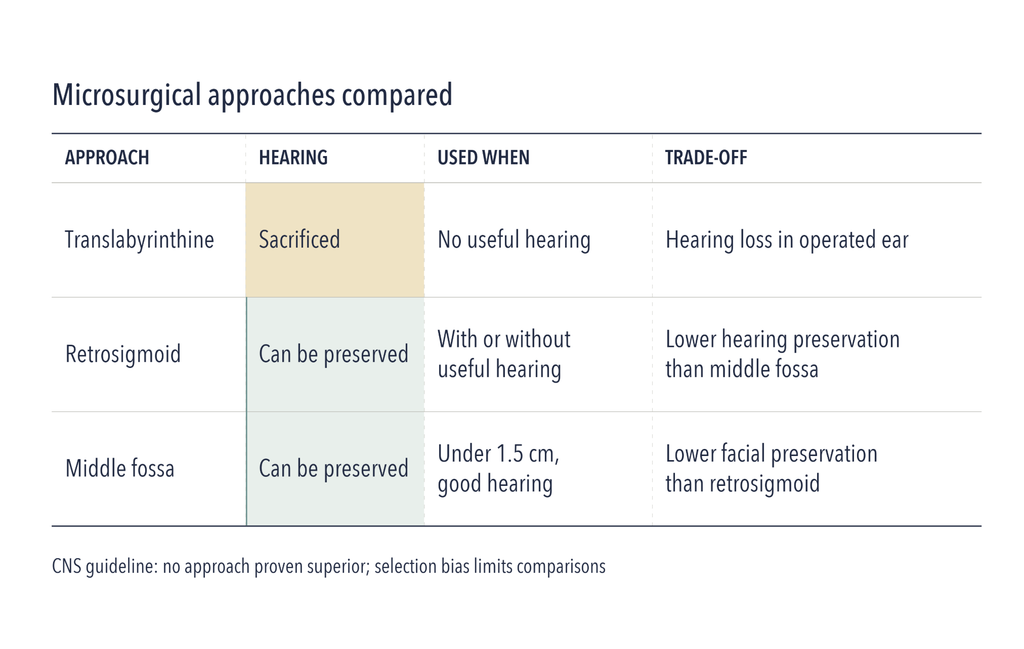
There are 3 microsurgical routes [Hamiter, MSD vestibular schwannoma, 2025]. The translabyrinthine approach goes through the inner ear, so it sacrifices hearing; surgeons use it when no useful hearing remains. The retrosigmoid approach and, for small tumors, the middle fossa approach can try to save hearing.
The CNS guideline finds no approach clearly better for complete removal or facial outcome and names tumor size as the strongest predictor of hearing and facial results [Van Gompel, CNS surgical resection update, 2026]. Hearing preservation surgery by either route is an option for tumors under 1.5 cm with good hearing [Hadjipanayis, CNS surgical resection guideline, 2018]. With small tumors, 40% to 70% of patients keep serviceable hearing after microsurgery; above 2.5 cm, fewer than 5% do [Mayo Clinic, VS treatment decisions, 2022].
Surgeons sometimes leave a thin remnant on the facial nerve to avoid paralysis, at the cost of more regrowth [Mayo Clinic, Shared decision-making, 2021]. Compared with gross total resection, the pooled recurrence risk was 2.94 times higher after near-total and 11.50 times higher after subtotal resection [Kocharyan, Near-total and subtotal resection, 2024]. In an older meta-analysis, cerebrospinal fluid (CSF) leak followed 9.5% to 10.6% of operations, with similar rates across approaches [Selesnick, CSF leak meta-analysis, 2004].
Key Takeaways
- Vestibular schwannoma is a benign Schwann cell tumor of the vestibular nerve; “acoustic neuroma” is the older, inaccurate name.
- Hearing symptoms are more common than dizziness, and hearing loss is usually gradual but can be sudden.
- Recovery after steroids does not rule out a tumor, so SSNHL still calls for MRI or ABR.
- MRI confirms the diagnosis without routine biopsy, and no drug controls sporadic tumors.
- Size, growth, location, hearing, and brainstem compression guide the choice between wait-and-scan, radiosurgery, and surgery.
FAQ
Is acoustic neuroma the same as vestibular schwannoma?
Yes. Both names describe the same benign tumor. Vestibular schwannoma is the preferred term because the tumor arises from Schwann cells of the vestibular nerve [NIH, Acoustic neuroma consensus, 1991].
Is there a medicine for vestibular schwannoma?
No, not for sporadic tumors. Aspirin showed no significant association with growth, and metformin data are early and retrospective [Zalaquett, Medical therapy meta-analysis, 2026]. Bevacizumab has a role only in NF2 [Goldbrunner, EANO VS guideline, 2020].
References
- NIH Consensus Development Conference. Acoustic neuroma. NIH Consens Statement. 1991;9(4):1-24.
- Hamiter M. Vestibular schwannoma [Internet]. MSD Manual Professional Version. Rahway (NJ): Merck & Co., Inc.; 2025 [cited 2026 Nov 24]. Available from: https://www.msdmanuals.com/professional/ear,-nose,-and-throat-disorders/inner-ear-disorders/vestibular-schwannoma
- Wasano K, Oishi N, Noguchi M, Hentona K, Shinden S, Kitama T, et al. Sudden sensorineural hearing loss in patients with vestibular schwannoma. Sci Rep. 2021;11(1):1624.
- Marinelli JP, Beeler CJ, Carlson ML, Caye-Thomasen P, Spear SA, Erbele ID. Global incidence of sporadic vestibular schwannoma: a systematic review. Otolaryngol Head Neck Surg. 2022;167(2):209-214.
- Mayo Clinic. Expert guidance for vestibular schwannomas’ complex treatment decisions [Internet]. Rochester (MN): Mayo Clinic; 2022 [cited 2026 Nov 24]. Available from: https://www.mayoclinic.org/medical-professionals/neurology-neurosurgery/news/expert-guidance-for-vestibular-schwannomas-complex-treatment-decisions/mac-20534886
- Plotkin SR, Messiaen L, Legius E, Pancza P, Avery RA, Blakeley JO, et al. Updated diagnostic criteria and nomenclature for neurofibromatosis type 2 and schwannomatosis: an international consensus recommendation. Genet Med. 2022;24(9):1967-1977.
- Matthies C, Samii M. Management of 1000 vestibular schwannomas (acoustic neuromas): clinical presentation. Neurosurgery. 1997;40(1):1-9; discussion 9-10.
- Sauvaget E, Kici S, Kania R, Herman P, Tran Ba Huy P. Sudden sensorineural hearing loss as a revealing symptom of vestibular schwannoma. Acta Otolaryngol. 2005;125(6):592-5.
- Lee SA, Kim SY, Lee Y, Lee JD. Efficacy of steroid treatment for sudden sensorineural hearing loss in patients with vestibular schwannoma. Acta Otolaryngol. 2022;142(5):402-405.
- Fujita T, Saito K, Kashiwagi N, Sato M, Seo T, Doi K. The prevalence of vestibular schwannoma among patients treated as sudden sensorineural hearing loss. Auris Nasus Larynx. 2019;46(1):78-82.
- Huynh PP, Saba ES, Hoerter JE, Jiang N. Steroid efficacy on audiologic recovery in patients with sudden sensorineural hearing loss and vestibular schwannoma: a retrospective review. Otol Neurotol. 2023;44(8):780-785.
- Chandrasekhar SS, Tsai Do BS, Schwartz SR, Bontempo LJ, Faucett EA, Finestone SA, et al. Clinical practice guideline: sudden hearing loss (update). Otolaryngol Head Neck Surg. 2019;161(1_suppl):S1-S45.
- Goldbrunner R, Weller M, Regis J, Lund-Johansen M, Stavrinou P, Reuss D, et al. EANO guideline on the diagnosis and treatment of vestibular schwannoma. Neuro Oncol. 2020;22(1):31-45.
- Fortnum H, O’Neill C, Taylor R, Lenthall R, Nikolopoulos T, Lightfoot G, et al. The role of magnetic resonance imaging in the identification of suspected acoustic neuroma: a systematic review of clinical and cost effectiveness and natural history. Health Technol Assess. 2009;13(18):iii-iv, ix-xi, 1-154.
- Dunn IF, Bi WL, Mukundan S, Delman BN, Parish J, Atkins T, et al. Congress of Neurological Surgeons systematic review and evidence-based guidelines on the role of imaging in the diagnosis and management of patients with vestibular schwannomas. Neurosurgery. 2018;82(2):E32-E34.
- Ignacio KHD, Espiritu AI, Diestro JDB, Chan KI, Dmytriw AA, Omar AT. Efficacy of aspirin for sporadic vestibular schwannoma: a meta-analysis. Neurol Sci. 2021;42(12):5101-5106.
- Zalaquett NG, Khandalavala KR, Epperson MV, Marinelli JP, Lohse CM, Chelf CJ, et al. Current evidence on medical therapy for sporadic vestibular schwannoma: a systematic review and meta-analysis. Otol Neurotol. 2026;47(6):846-852.
- Lu VM, Ravindran K, Graffeo CS, Perry A, Van Gompel JJ, Daniels DJ, et al. Efficacy and safety of bevacizumab for vestibular schwannoma in neurofibromatosis type 2: a systematic review and meta-analysis of treatment outcomes. J Neurooncol. 2019;144(2):239-248.
- Reznitsky M, Petersen MMBS, West N, Stangerup SE, Cayé-Thomasen P. The natural history of vestibular schwannoma growth-prospective 40-year data from an unselected national cohort. Neuro Oncol. 2021;23(5):827-836.
- Daher GS, Marinelli JP, Van Gompel JJ, Patel NS, Olson JJ, Carlson ML. Congress of Neurological Surgeons systematic review and evidence-based guideline on hearing preservation outcomes in patients with sporadic vestibular schwannoma: update. Neurosurgery. 2026;98(2):298-302.
- Savardekar AR, Terrell D, Lele SJ, Diaz R, Keesari PR, Trosclair K, et al. Primary treatment of small to medium (<3 cm) sporadic vestibular schwannomas: a systematic review and meta-analysis on hearing preservation and tumor control rates for microsurgery versus radiosurgery. World Neurosurg. 2022;160:102-113.e12.
- Van Gompel JJ, Carlstrom LP, Hadjipanayis CG, Graffeo CS, Patel N, Carlson ML, et al. Congress of Neurological Surgeons systematic review and evidence-based guideline on surgical resection for the treatment of patients with vestibular schwannomas: update. Neurosurgery. 2026;98(2):272-277.
- Hadjipanayis CG, Carlson ML, Link MJ, Rayan TA, Parish J, Atkins T, et al. Congress of Neurological Surgeons systematic review and evidence-based guidelines on surgical resection for the treatment of patients with vestibular schwannomas. Neurosurgery. 2018;82(2):E40-E43.
- Mayo Clinic. Vestibular schwannoma: meeting each patient’s needs through shared decision-making [Internet]. Rochester (MN): Mayo Clinic; 2021 [cited 2026 Nov 24]. Available from: https://www.mayoclinic.org/medical-professionals/neurology-neurosurgery/news/vestibular-schwannoma-meeting-each-patients-needs-through-shared-decision-making/mac-20517187
- Kocharyan A, Daher GS, Curry SD, Klimara MJ, Farrokhian N, Coleman S, et al. Outcomes of near-total and subtotal resection of sporadic vestibular schwannoma: a systematic review and meta-analysis. Otolaryngol Head Neck Surg. 2024;171(3):642-657.
- Selesnick SH, Liu JC, Jen A, Newman J. The incidence of cerebrospinal fluid leak after vestibular schwannoma surgery. Otol Neurotol. 2004;25(3):387-93.
Joonpyo Hong, MD is a board-certified otolaryngologist practicing in Korea. This article reflects his clinical interpretation of published research and does not constitute individual medical advice.
For more articles:
https://curiousmd.com/sudden-hearing-loss-prognostic-factors/
https://curiousmd.com/hyperbaric-oxygen-for-sudden-hearing-loss/
Link out to:
https://www.msdmanuals.com/professional/ear,-nose,-and-throat-disorders/inner-ear-disorders/vestibular-schwannoma : MSD Manual Professional Version review of vestibular schwannoma presentation, workup, and treatment options.
https://www.nidcd.nih.gov/health/vestibular-schwannoma-acoustic-neuroma-and-neurofibromatosis : NIDCD (NIH) overview of vestibular schwannoma, its diagnosis and treatment, and its link to NF2.
https://www.mayoclinic.org/medical-professionals/neurology-neurosurgery/news/expert-guidance-for-vestibular-schwannomas-complex-treatment-decisions/mac-20534886 : Mayo Clinic experts on size thresholds, wait-and-scan, radiosurgery, and microsurgery choices.